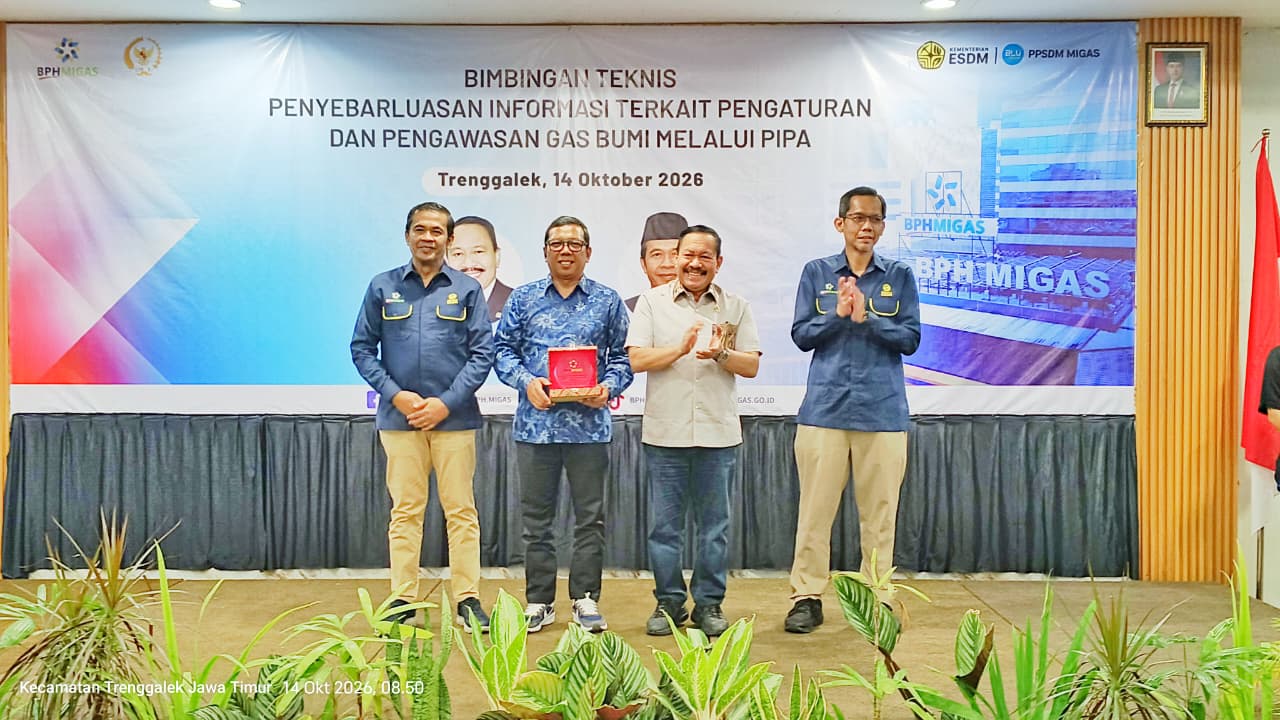
PGN Supports the Development of a Natural Gas Pipeline Network in Trenggalek for Households and SMEs
Trenggalek – PT Perusahaan Gas Negara (Persero) Tbk (PGN), as Pertamina’s Gas Subholding, is supporting efforts to develop the use of natural gas via pipeline networks for households and micro, small and medium-sized enterprises (MSMEs) in Trenggalek Regency, East Java. This initiative is in line with PGN’s commitment to expanding access to practical, efficient and more environmentally friendly energy, whilst optimising the utilisation of domestic natural gas to support national energy security.
This support is demonstrated through PGN’s participation in technical guidance (bimtek) and awareness-raising activities regarding the regulation and supervision of piped natural gas, organised by the Downstream Oil and Gas Regulatory Agency (BPH Migas) in collaboration with members of Commission XII of the Indonesian House of Representatives and PGN in Trenggalek Regency.
This initiative served as a platform to enhance public understanding of the benefits of using natural gas via pipeline networks, whilst also facilitating discussion on the potential for developing natural gas infrastructure that can support both household energy needs and community economic activities.
On this occasion, the Director of Natural Gas at BPH Migas, Muhiddin, explained that the use of natural gas via pipeline networks can bring convenience to the public. Through the domestic natural gas network (jargas), gas is supplied directly to customers’ homes via pipelines, meaning the public no longer needs to purchase and regularly replace gas cylinders.
The development of the jargas scheme is also part of an effort to increase the utilisation of domestic natural gas whilst reducing dependence on imported LPG. “With this jargas programme, we will be able to reduce LPG imports, which currently stand at 7.5 million tonnes per year,” said Muhiddin.
Meanwhile, Dr Sartono, a member of Commission XII of the Indonesian House of Representatives, emphasised that the regulation and supervision of natural gas distribution via pipelines play a strategic role in supporting energy security, industrial competitiveness, investment certainty and consumer protection. The development of natural gas infrastructure must be carried out in an integrated manner, from the availability of supply sources to distribution to end consumers, so as to provide tangible benefits for the community and the regional economy.
He also highlighted opportunities for developing a natural gas network in the Mataraman region, including Trenggalek Regency, taking into account the region’s potential and the community’s energy needs. “Opportunities for natural gas network development need to be discussed further with relevant ministries and agencies, taking into account the region’s potential and the community’s needs,” said Sartono.
Heri Frastiono, Area Head of PGN Sidoarjo, stated that Trenggalek Regency possesses local economic potential that could be a key consideration in the development of natural gas utilisation, particularly to support community business activities.
A variety of local speciality products, such as tempeh crisps, alen-alen, and other processed goods, reflect the activities of small and medium-sized enterprises (SMEs) that require energy to support their production processes. The use of natural gas has the potential to become a practical and efficient alternative energy source for business operators, provided it is supported by adequate supply and infrastructure.
“Natural gas offers advantages in terms of practicality, convenience, potential for energy cost efficiency, and cleaner combustion characteristics. For SME operators, the availability of reliable and sustainable energy is a key factor in ensuring the smooth running of production processes and business development,” explained Heri.
Heri added that the development of natural gas utilisation in a region must take various aspects into account, including supply availability, infrastructure readiness, potential customer demand, and the economic viability of network development.
“PGN remains open to collaborating with the government and stakeholders to identify the potential for developing natural gas utilisation in various regions, including Trenggalek. Through synergy and measured planning, we hope that the benefits of domestic natural gas can reach more members of the public and business operators,” added Heri.
Through this awareness-raising initiative, PGN, together with BPH Migas, the Indonesian House of Representatives (DPR RI), and relevant stakeholders, is helping to promote greater public understanding of the benefits, safety, and utilisation of natural gas via pipeline networks.
Moving forward, PGN will continue to support efforts to develop the utilisation of natural gas, taking into account supply readiness, infrastructure, and market demand. Synergy between the government, regulators, the legislature, businesses, and the public is expected to open up opportunities for the expansion of sustainable domestic energy access, whilst supporting the productivity of MSMEs and regional economic growth.
About PGN
PT Perusahaan Gas Negara (Persero) Tbk (PGN) is Pertamina's Gas Subholding, operating in the transmission and distribution of natural gas, as well as the development of integrated natural gas infrastructure and services in Indonesia. PGN manages over 95% of the country's downstream natural gas infrastructure to support Indonesia's energy security and energy transition. PGN also controls over 90% of the commercial natural gas market in Indonesia.
Disclaimer:
This press release contains forward looking statements based on the Company's current data and expectations, which involve a number of risks, uncertainties, and assumptions. Factors that may cause actual results to differ materially include industry conditions, fluctuations in crude oil and gas prices, the Company's ability to obtain and execute new projects, and competitive dynamics. Should one or more of these risks or uncertainties occur, or should the underlying assumptions prove inaccurate, the actual results may differ materially from those stated or anticipated.